Research Article | | Peer-Reviewed

Impact Analysis of Renal Function, Blood Glucose, and Lipid Levels on Cognitive Dysfunction in the Elderly in Southwest China

Received: 14 October 2025     Accepted: 26 October 2025     Published: 22 November 2025
Views:       Downloads:
Abstract

Objective: To investigate the correlation between blood glucose, blood lipids, and renal function with the prevalence of cognitive impairment in elderly individuals aged 65 and above in this region, and to analyze the influencing factors. Methods: This study adopted a cross-sectional design, selecting 11,510 residents from nine communities in this region who participated in elderly health examinations from 2022 to 2023 as the study subjects. Demographic data (age, gender, education level), medical history, and other baseline information were collected through standardized questionnaires. Laboratory data such as fasting blood glucose, blood lipids, and renal function were measured, and cognitive function status was assessed using the Mini-Mental State Examination (MMSE) to determine the prevalence of cognitive impairment in individuals aged ≥65 in this region. Data analysis was performed using SPSS 25.0 software, and univariate and multivariate logistic regression analyses were conducted to examine the impact of blood glucose, blood lipids, and renal function on cognitive impairment. Results: Among the 11,510 elderly individuals, 2,803 had cognitive impairment, with a prevalence rate of 24.4%. The results showed that hypoglycemia, hyperglycemia, triglycerides, cholesterol, low-density lipoprotein, glomerular filtration rate, age, gender, and education level had significant effects on cognitive impairment (P < 0.05), while high-density lipoprotein cholesterol showed no significant association. Conclusion: Female gender, advanced age, low education level, hypoglycemia, hyperglycemia, high triglycerides, high cholesterol, low-density lipoprotein cholesterol, and decreased glomerular filtration rate are risk factors for cognitive impairment in the elderly population of this region.

Published in American Journal of Clinical and Experimental Medicine (Volume 13, Issue 6)
DOI 10.11648/j.ajcem.20251306.11
Page(s) 162-169
Creative Commons

This is an Open Access article, distributed under the terms of the Creative Commons Attribution 4.0 International License (http://creativecommons.org/licenses/by/4.0/), which permits unrestricted use, distribution and reproduction in any medium or format, provided the original work is properly cited.

Copyright

Copyright © The Author(s), 2025. Published by Science Publishing Group

Keywords

Renal Function, Blood Glucose, Blood Lipid, Cognitive Dysfunction, Prevalence

1. Introduction
In recent years, the prevalence of cognitive dysfunction among the elderly has shown a continuous upward trend, with the current global patient population exceeding 50 million, making it a common health issue among the elderly. It is projected that by the middle of this century, the number of affected individuals will rapidly increase to 152 million . Research indicates that the incidence of dementia increases exponentially with age, doubling every five years, with a new case of dementia emerging globally every three seconds . As a populous country, the prevention of dementia is particularly crucial in China. To address the peak of aging, the current strategy primarily involves early screening and treatment to identify risk factors. Therefore, clarifying the risk factors for cognitive dysfunction is of significant importance for the prevention of dementia.
2. Materials and Methods
2.1. Research Subjects
This study employed a cross-sectional research design, with 11,510 elderly individuals aged 65 and above who participated in the free health examination program in the local area during 2022-2023 as the study subjects. Inclusion criteria: elderly population aged 65-90 years who voluntarily participated in the health examination; Exclusion criteria: (1) individuals clinically diagnosed with mental illnesses; (2) individuals unable to care for themselves; (3) individuals who refused to participate in this study. The study protocol has been approved by the hospital's ethics committee.
2.2. Data Sources
This study primarily included populations from nine local communities and a small number of outpatients from Guandu District People's Hospital, totaling 11,510 elderly participants aged 65 to 90 years, with an average age of 70.99 years. The gender composition was 4,848 males (42.12%) and 6,662 females (57.88%). The distribution of educational levels among the participants was as follows: 2,149 illiterate (18.67%), 4,736 primary school graduates (41.14%), 3,624 middle school (including technical secondary school) graduates (31.49%), and 1,001 university (including college) graduates (8.70%). The gender composition was predominantly female (6,662 cases, 57.88%), with 4,848 males (42.12%). Routine physical examination items such as liver and kidney function, blood glucose, blood lipids, B-ultrasound, and electrocardiogram were performed on 11,646 elderly individuals. Participants were informed the day before the examination that they needed to fast for blood tests the following day. The biochemical testing equipment used in the nine community centers was the Dirui CS-600B biochemical analyzer. Cognitive function screening was conducted by uniformly trained community healthcare professionals in a relatively independent and enclosed space, completed through face-to-face, one-on-one interviews (using the Mini-Mental State Examination scale). Medical history and educational background were simultaneously collected by community doctors at the examination site, with the classification standard for educational level as follows: no formal education as illiterate, primary school graduation as primary school, junior high school or technical secondary school graduation as middle school, and university or college graduation as university.
2.3. Assessment of Cognitive Function
The cognitive function of elderly individuals was assessed using the Mini-Mental State Examination (MMSE) to determine the prevalence of cognitive impairment among local residents aged 65 and above. The MMSE was administered by trained psychological assessors and included fundamental evaluations of orientation, attention and calculation, recall, and language abilities, comprising a total of 30 sections with a score range of 0–30. Lower scores indicate more severe cognitive impairment..
2.4. Control for Confounding Factors
This study collected potential confounding risk factors associated with cognitive impairment through physical examinations, including gender, age, and educational level; educational level was categorized into illiteracy, primary school, secondary school (vocational school), and university (college).
3. Statistical Processing
Data analysis was performed using SPSS 25.0 statistical software. For measurement data, normality tests were first conducted. Continuous variables conforming to normal distribution were expressed as mean ± standard deviation, while non-normally distributed continuous variables were expressed as median (interquartile range). If all groups satisfied normal distribution and homogeneity of variance, independent samples t-test was used; for non-normally distributed measurement data, rank-sum test was employed. Count data were analyzed using chi-square test, while ordinal data were analyzed through rank-sum test. The association between independent variables (e.g., BMI) and dependent variables (cognitive performance) was preliminarily analyzed using logistic regression model. Multiple logistic regression was employed to set dummy variables and determine the odds ratio (OR) and its 95% confidence interval (CI) for each group. All statistical results were considered significant when P < 0.05.
4. Results
4.1. Correlation Analysis Between Age, Gender and Cognitive Impairment
The research team collected data from 11,510 elderly individuals over a two-year period. A univariate logistic analysis revealed correlations between cognitive impairment and demographic indicators including age, gender, geographic distribution, and educational attainment. When analyzing the cohort divided by gender and 5-year age groups, no significant differences in age distribution were observed. However, the incidence of cognitive impairment increased with age, while older women exhibited lower MMSE scores . Male participants averaged 24.35 on the MMSE, significantly lower than females' average score of 23.26. The analysis showed that compared to the 65-74 age group (risk = 1), the risk of cognitive impairment increased 2.5-fold for those aged 75-84 years and 2.7-fold for those over 85 years old. (Table 1).
Table 1. Influence of general information (age, gender, educational background) on MMSE values.

Variables

Single factor

multiple factor

b

S. E

t

P

b

S. E

t

P

age

-0.17

0.01

-19.23

<.001

-0.17

0.01

-20.36

<.001

Gender (control: male)

woman

-1.07

0.09

-12.13

<.001

-0.42

0.09

-4.91

<.001

Education (compared to: illiterate)

primary school

2.69

0.11

23.54

<.001

2.6

0.11

23.55

<.001

middle school

4.63

0.12

38.79

<.001

4.31

0.12

35.49

<.001

senior middle school

4.82

0.17

28.83

<.001

5.14

0.17

29.5

<.001

4.2. The Effect of Blood Glucose Levels and the Course of Diabetic Disease on Cognitive Dysfunction
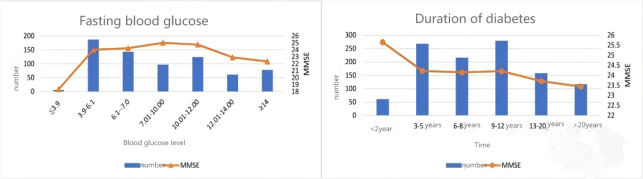
This study conducted a statistical analysis of fasting blood glucose levels and disease duration in 1,099 diabetic patients. The results showed that MMSE scores peaked when fasting blood glucose ranged between 7.01 and 10.00 mmol/L. Conversely, MMSE scores were lowest in patients with hyperglycemia (>10.00 mmol/L) or hypoglycemia (<3.9 mmol/L), particularly when fasting glucose levels were below 3.9 mmol/L. The prevalence of cognitive impairment exhibited a U-shaped distribution pattern. Additionally, the duration of diabetes was associated with higher rates of cognitive impairment. Overall, individuals with longer durations of diabetes, hypoglycemia, or hyperglycemia showed significantly increased prevalence of cognitive impairment (Figure 1 for details).
Figure 1. Fasting blood glucose and diabetic disease course analysis.
4.3. Correlations Among Blood Glucose, Lipids, Glomerular Filtration Rate, and Cognitive Impairment
A Analysis of the differences in the prevalence of cognitive impairment among different indicators of blood glucose, blood lipids, and glomerular filtration rate in 11,510 elderly individuals who completed liver and kidney function, blood glucose, and blood lipid tests. According to the Chinese Guidelines for Blood Lipid Management (2024 Edition), the research team divided triglycerides into three groups: less than 1.7 mmol/L, greater than or equal to 1.7 mmol/L and less than 2.26 mmol/L, and greater than or equal to 2.26 mmol/L. It was observed that the higher the triglyceride level, the higher the incidence of cognitive dysfunction. Cholesterol was categorized based on the normal values provided by the testing center: less than 5.2 mmol/L, greater than or equal to 5.2 mmol/L and less than 6.2 mmol/L, and greater than or equal to 6.2 mmol/L. It was found that the incidence of cognitive dysfunction was higher in elderly individuals with higher cholesterol levels. Similarly, for low-density lipoprotein cholesterol, the incidence increased with higher levels. High-density lipoprotein was divided into less than 1.04 mmol/L, greater than or equal to 1.04 mmol/L and less than 1.55 mmol/L, and greater than or equal to 1.55 mmol/L. The results showed that the lower the high-density lipoprotein level, the higher the incidence of cognitive dysfunction in elderly individuals. The glomerular filtration rate was calculated using the MDRD equation: =175*((serum creatinine/88.4) ^ (-1.154)) * (age ^ (-0.203)) * 0.742 (for females). According to CKD classification, the prevalence of cognitive dysfunction was 48.48%, 33.54%, 23.21%, and 17.98% for eGFR less than 30 ml/min, 30 ml/min to 60 ml/min, 60 ml/min to 90 ml/min, and greater than or equal to 90 ml/min, respectively, with a P-value less than 0.05, indicating statistical significance (P<0.05).
After adjusting for gender, age, and education level using the proportional hazards model, quartile calculations were performed for EGFR, triglycerides, cholesterol, blood glucose, and low-density lipoprotein cholesterol. It was observed that the incidence of cognitive dysfunction increased with lower glomerular filtration rates. Additionally, the incidence of cognitive dysfunction increased with higher levels of triglycerides, cholesterol, low-density lipoprotein cholesterol, and blood glucose; all linear trends across quartiles were significant with P < 0.001.(Table 2)
Table 2. Correlation analysis between blood glucose, blood lipid, glomerular filtration rate and prevalence of cognitive impairment.

Metric

Group

N

Prevalence of cognitive dysfunction (%)

t

P

Fasting blood glucose groups

<3.9

24

20.15

1.394

0.028

<=3.9<7.01

7741

26.28

>=7.01

3745

23.36

Triglyceride groups

<1.7

6237

23.62

-0.982

0.026

<=1.7<2.26

2333

25.99

>=2.26

2940

28.67

Cholesterol groups

<5.2

2547

22.42

4.486

0.000

<=5.2<6.2

5431

24.68

>=6.2

3532

26.59

LDL groupings

<3.4

7093

23.6

-2.845

0.004

<=3.4<4.1

2457

25.91

>=4.1

1910

28.05

HDL groupings

<1.04

1258

32.15

1.247

0.017

<=1.04<1.55

6824

28.74

>=1.55

3428

24.07

Glomerular filtration rate groups

<30

49

48.48

3.647

0.023

<=30<60

1593

33.54

<=60<90

6920

23.21

>=90

2948

17.98

4.4. Analysis of Blood Lipids, Glomerular Filtration Rate, and Cognitive Impairment by Quartile
In a study involving 11,510 elderly individuals who underwent comprehensive tests including liver/kidney function, blood glucose, and lipid profiles, fasting blood glucose levels, lipid parameters, and glomerular filtration rate (GFR) were ranked from lowest to highest. Participants were divided into four groups: Q1 (25%), Q2 (50%), Q3 (75%), and Q4 (100%). Analysis of cognitive impairment prevalence across these groups revealed that lower GFR levels were associated with higher cognitive impairment rates, indicating a strong correlation between chronic kidney disease and renal dysfunction with the development of cognitive decline. Elevated levels of triglycerides, cholesterol, and low-density lipoprotein (LDL) were identified as risk factors for cognitive impairment. Conversely, while high-density lipoprotein (HDL) levels showed no significant association with cognitive impairment incidence, their elevation did not lead to a corresponding reduction in prevalence. This study concluded that elevated HDL cholesterol levels were not correlated with cognitive impairment occurrence (Table 3).
Table 3. Correlation Analysis of Lipid Levels, Glomerular Filtration Rate, and Cognitive Impairment Prevalence across Quartile Groups.

Alzheimer's disease

quartile #

Each increase of 1SD

1

2

3

4

GFR

case rate, %

26.10

25.27

24.63

24.0

2.8

hazard ratio *

(95%CI)

1 [Reference]

1.026

(0.904-1.166)

1.0529

(0.932-1.189)

1.0875

(0.932-1.229)

1.028$

(1.020-1.036)

glycerin trilaurate

Incidence of events, %

23.03

24.78

25.25

26.94

hazard ratio *

(95%CI)

1 [Reference]

0.85

(0.75-0.96)

0.92

(0.82-1.04)

0.94

(0.84-1.05)

1.05$

(1.02-1.08)

cholesterol

Incidence of events, %

24.42

24.8

26.27

27.51

hazard ratio *

(95%CI)

1 [Reference]

1.036 (0.931-1.151)

1.141 (1.028-1.266)

1.251 (1.132-1.382)

1.070 $ (1.038-1.101)

LDL

Incidence of events, %

22.9

24.4

25.94

26.76

hazard ratio *

(95%CI)

1 [Reference]

1.09

(1.00-1.19)

1.19

(1.08-1.31)

1.24

(1.13-1.36)

1.09$

(1.00-1.19)

HDL

Incidence of events, %

27.5

24.44

23.78

24.28

hazard ratio * (95%CI)

1 [Reference]

0.886 (0.762-1..29)

0.861 (0.724-1.023)

0.895 (0.77-1..36)

0.914$ (0.829-0.992)

5. Discussion
This study revealed that among the 11,510 elderly participants in the project, 2,803 individuals were diagnosed with cognitive impairment, resulting in a cognitive dysfunction prevalence rate of 24.35%. This rate is significantly higher than the incidence rates reported in some international studies (e.g., 0.85%-7.7% as reported by Bischlzopf) , however, the findings of Ravaglia based on the Stockholm Conference criteria (4-year cumulative incidence of 22.6%) . This elevated prevalence may be closely related to socioeconomic and cultural factors, as well as the distribution of medical resources in the region. As an underdeveloped area, Yunnan may harbor the following risk factors.
Educational inequality: Low educational attainment is a clear risk factor, with limited educational opportunities for women in this region potentially exacerbating this impact. Aging and low social engagement: Reduced social activities after retirement may lead to insufficient cognitive stimulation, thereby accelerating cognitive decline. Healthcare accessibility: Inadequate management of chronic conditions such as hypertension and diabetes could indirectly affect cognitive health.
The complex interplay between gender and cognitive impairment remains unclear. While this study did not directly establish gender as an independent risk factor, women exhibit significantly higher incidence rates than men (particularly among older populations), which may be attributed to three key factors: Socio-cultural factors: Women generally have lower educational attainment than men, and their social roles may limit later-life social engagement and cognitive stimulation. Biological differences: The impact of fluctuations in estrogen levels on female cognitive function requires further investigation. Confounding factors: Gender disparities might indirectly affect cognitive function through mediating variables such as education, occupation, and socioeconomic status, which demands validation through multivariate models.
The protective role of educational attainment. Low educational level serves as an independent risk factor for cognitive dysfunction, consistent with most studies (e.g., Meng Chen et al.) . Potential mechanisms include: 1) The cognitive reserve hypothesis: Higher education enhances neural synaptic plasticity and improves brain network efficiency, thereby delaying cognitive decline. 2) Health behavior differences: Educated individuals may prioritize health management practices (e.g., chronic disease control and healthy diets), which indirectly safeguard cognitive function. 3) Access to social resources: Those with higher education levels typically have better access to medical resources and health information, reducing disease risks.
Significance of metabolic and renal function indicators. Blood lipids (triglycerides, cholesterol, LDL) and renal function (urea nitrogen, creatinine, GFR), along with blood glucose levels, show significant correlations with cognitive impairment prevalence, suggesting the following mechanisms: 1. Vascular damage: Dyslipidemia may impair cerebral blood flow through atherosclerosis, leading to vascular cognitive impairment. 2. Kidney-brain axis association: Impaired kidney function may cause uremic toxin accumulation, inflammatory factor release, or metabolic disorders (e.g., abnormal calcium-phosphorus metabolism), directly or indirectly damaging neurons. 3. Metabolic syndrome synergy: Multiple metabolic abnormalities (e.g., dyslipidemia + renal dysfunction) may synergistically exacerbate oxidative stress and neuroinflammation, accelerating cognitive decline. 4. Hyperglycemia: May disrupt cognitive function by affecting cerebral vascular function and neurotransmitter balance. Research by VAN AGTMAAL et al found that hyperglycemia induces neurodegeneration through polyols, hexosamine, and advanced glycation end products (AGEs), leading to neuronal metabolic disorders that impair survival and function. Impaired energy metabolism in damaged neurons slows neural transmission, resulting in memory, attention, and executive function decline. Additionally, hyperglycemia reduces β-amyloid clearance and increases amyloid levels in the body – a critical neuropathological mechanism underlying dementia. LUANA et al. found that elevated peripheral blood glucose levels lead to decreased transmembrane transport of glucose into the brain through GLUT-1 and GLUT-3 in glucose transporters (GLUT), ultimately resulting in cognitive decline. HDL-C, recognized as a "good" lipid complex, facilitates cholesterol clearance through reverse transport to maintain systemic balance Multiple studies demonstrate an inverse correlation between HDL-C levels and cognitive impairment, with reduced HDL-C levels increasing the risk of cognitive disorders In this study, elevated HDL-C levels were associated with lower cognitive impairment prevalence. The quartile analysis showed the top 25% HDL-C values at 1.39 mmol/L, which falls within normal lipid parameters, further supporting the negative correlation between HDL-C levels and cognitive impairment.
6. Conclusions
In this study, the overall prevalence of cognitive impairment among participants aged 65 and above was 24.35%. The results showed that gender, age, education level, triglycerides, cholesterol, low-density lipoprotein (LDL), abnormal kidney function, and hyperglycemia were associated with cognitive impairment. Notably, female gender, hyperglycemia, high triglyceride levels, elevated cholesterol levels, mixed LDL levels, and decreased glomerular filtration rate were identified as risk factors for cognitive dysfunction.
Abbreviations

mmol/L

Millimole per Liter

MMSE

Mini-Mental State Examination

LDL

Low-density Lipoprotein

HDL

High-density Lipoprotein

GFR

Glomerular Filtration Rate

Funding
Clinical Research on Screening, Analysis and Intervention of Cognitive Dysfunction in the Elderly in a District of Kunming City 2022-03-7-002.
Conflicts of Interest
The authors declare no conflicts of interest.
References
[1] Sun Jingxian, Zeng Hui. Advances in Intervention Research for Mild Cognitive Impairment [J]. China General Practice, 2012, 15(15): 1681-1683.
[2] Jia J, Wang F, Wei C, et al. The prevalence of dementia in urban and rural areas of China [J]. Alzheimers & Dementia, 2014, 10(1): 1-9.
[3] Tricco AC, Soobiah C, Lillie E, et al. Use of cognitive enhancers for mild cognitive impairment: protocol for a systematic review and network meta-analysis [J]. Syst Rev, 2012, 1(25): 2046-4053.
[4] Petersen RC. Clinical practice. Mild cognitive impairment [J]. N Engl J Med, 2011, 364(23): 2227-2234.
[5] Eshkoor SA, Hamid TA, Mun CY, et al. Mild cognitive impairment and its management in older people [J]. Clin Interv Aging, 2015, 10: 687-693.
[6] Barekatain M, Zahedian F, Askarpour H, et al. Coronary artery disease and plasma apolipoprotein E4 in mild cognitive impairment [J]. ARYA Atheroscler, 2014, 10(5): 244 - 251.
[7] Sun JX, Zeng H. Research progresses of interventions on mild cognitive impairment [J]. Chinese General Practise, 2012, 15(5): 1681.
[8] Li B, Zhu YX, Wang T. The research progress on risk factors for cognitive impairment after ischemic stroke [J]. Chin J Clinicians(Electronic Edition), 2013, 7(16): 7544-7546.
[9] J Bischkopf, A Busse, M C Angermeyer. Mild cognitive impairment--a review of prevalence, incidence and outcome according to current approaches. Acta Psychiatr Scand 2002, Dec; 106(6): 403-14.
[10] Giovanni Ravaglia, Paola Forti, Fabiola Maioli et al. Education, occupation, and prevalence of dementia: findings from the Conselice study. Dement Geriatr Cogn Disord 2002; 14(2): 90-100.
[11] Wang Yin-hua, Chen Xiao-hong, Tang Zhe, Meng Chen. Neuropsychological research on mild cognitive impairment and ApoE gene polymorphism analysis. China Rehabilitation Theory and Practice, 2005, 3(3): 45-48.
[12] VAN AGTMAAL MJM, HOUBEN AJHM, DE WIT V, et al. Prediabetes is associated with structural brain abnor malities: the maastricht study [J]. Diabetes Care, 2018, 41(12): 2535-2543.
[13] LUANA LL, GRO T, MARIA LB, et al. Does hyperglycemia downregulate glucose transporters in the brain? [J]. Medical Hypotheses, 2020, 139: 109614.
[14] PEDRINIS, HONEE, GUPTAVB, etal. Plasma high density lipoprotein small subclass is reduced in Alzheimer's disease patients and correlates with cognitive performance [J]. Journal of Alzheimer's Disease, 2020, 77(2): 733-744.
[15] SVENSSONT, SAWADA N, MIMURA M, et al. The association between midlife serum high-density lipoprotein and mild cognitive impairment and dementia after19 years of follow-up [J]. Translational Psychiatry, 2019, 9(1): 26.
[16] Wang M, Li Y, Cong L, et al. High-density lipoprotein cholesterol and brain aging among rural-dwelling older adults: a population-based MRI study [J]. European Journal of Neurology [2025-10-07].
Cite This Article
  • APA Style

    Zhu, L., Yi, Q., Bai, C., Tian, W., Liu, L., et al. (2025). Impact Analysis of Renal Function, Blood Glucose, and Lipid Levels on Cognitive Dysfunction in the Elderly in Southwest China. American Journal of Clinical and Experimental Medicine, 13(6), 162-169. https://doi.org/10.11648/j.ajcem.20251306.11

    Copy | Download

    ACS Style

    Zhu, L.; Yi, Q.; Bai, C.; Tian, W.; Liu, L., et al. Impact Analysis of Renal Function, Blood Glucose, and Lipid Levels on Cognitive Dysfunction in the Elderly in Southwest China. Am. J. Clin. Exp. Med. 2025, 13(6), 162-169. doi: 10.11648/j.ajcem.20251306.11

    Copy | Download

    AMA Style

    Zhu L, Yi Q, Bai C, Tian W, Liu L, et al. Impact Analysis of Renal Function, Blood Glucose, and Lipid Levels on Cognitive Dysfunction in the Elderly in Southwest China. Am J Clin Exp Med. 2025;13(6):162-169. doi: 10.11648/j.ajcem.20251306.11

    Copy | Download

  • @article{10.11648/j.ajcem.20251306.11,
      author = {Ling Zhu and Qing-hua Yi and Can-hong Bai and Wei-li Tian and Li-jian Liu and Xiao-ping Ye and Li-ping Qiu and Feng-lian Yang and Shao-chang Ma and Zhi-fang Li and Li-ping Fu and Ding Luo},
      title = {Impact Analysis of Renal Function, Blood Glucose, and Lipid Levels on Cognitive Dysfunction in the Elderly in Southwest China
    },
      journal = {American Journal of Clinical and Experimental Medicine},
      volume = {13},
      number = {6},
      pages = {162-169},
      doi = {10.11648/j.ajcem.20251306.11},
      url = {https://doi.org/10.11648/j.ajcem.20251306.11},
      eprint = {https://article.sciencepublishinggroup.com/pdf/10.11648.j.ajcem.20251306.11},
      abstract = {Objective: To investigate the correlation between blood glucose, blood lipids, and renal function with the prevalence of cognitive impairment in elderly individuals aged 65 and above in this region, and to analyze the influencing factors. Methods: This study adopted a cross-sectional design, selecting 11,510 residents from nine communities in this region who participated in elderly health examinations from 2022 to 2023 as the study subjects. Demographic data (age, gender, education level), medical history, and other baseline information were collected through standardized questionnaires. Laboratory data such as fasting blood glucose, blood lipids, and renal function were measured, and cognitive function status was assessed using the Mini-Mental State Examination (MMSE) to determine the prevalence of cognitive impairment in individuals aged ≥65 in this region. Data analysis was performed using SPSS 25.0 software, and univariate and multivariate logistic regression analyses were conducted to examine the impact of blood glucose, blood lipids, and renal function on cognitive impairment. Results: Among the 11,510 elderly individuals, 2,803 had cognitive impairment, with a prevalence rate of 24.4%. The results showed that hypoglycemia, hyperglycemia, triglycerides, cholesterol, low-density lipoprotein, glomerular filtration rate, age, gender, and education level had significant effects on cognitive impairment (P < 0.05), while high-density lipoprotein cholesterol showed no significant association. Conclusion: Female gender, advanced age, low education level, hypoglycemia, hyperglycemia, high triglycerides, high cholesterol, low-density lipoprotein cholesterol, and decreased glomerular filtration rate are risk factors for cognitive impairment in the elderly population of this region.
    },
     year = {2025}
    }
    

    Copy | Download

  • TY  - JOUR
    T1  - Impact Analysis of Renal Function, Blood Glucose, and Lipid Levels on Cognitive Dysfunction in the Elderly in Southwest China
    
    AU  - Ling Zhu
    AU  - Qing-hua Yi
    AU  - Can-hong Bai
    AU  - Wei-li Tian
    AU  - Li-jian Liu
    AU  - Xiao-ping Ye
    AU  - Li-ping Qiu
    AU  - Feng-lian Yang
    AU  - Shao-chang Ma
    AU  - Zhi-fang Li
    AU  - Li-ping Fu
    AU  - Ding Luo
    Y1  - 2025/11/22
    PY  - 2025
    N1  - https://doi.org/10.11648/j.ajcem.20251306.11
    DO  - 10.11648/j.ajcem.20251306.11
    T2  - American Journal of Clinical and Experimental Medicine
    JF  - American Journal of Clinical and Experimental Medicine
    JO  - American Journal of Clinical and Experimental Medicine
    SP  - 162
    EP  - 169
    PB  - Science Publishing Group
    SN  - 2330-8133
    UR  - https://doi.org/10.11648/j.ajcem.20251306.11
    AB  - Objective: To investigate the correlation between blood glucose, blood lipids, and renal function with the prevalence of cognitive impairment in elderly individuals aged 65 and above in this region, and to analyze the influencing factors. Methods: This study adopted a cross-sectional design, selecting 11,510 residents from nine communities in this region who participated in elderly health examinations from 2022 to 2023 as the study subjects. Demographic data (age, gender, education level), medical history, and other baseline information were collected through standardized questionnaires. Laboratory data such as fasting blood glucose, blood lipids, and renal function were measured, and cognitive function status was assessed using the Mini-Mental State Examination (MMSE) to determine the prevalence of cognitive impairment in individuals aged ≥65 in this region. Data analysis was performed using SPSS 25.0 software, and univariate and multivariate logistic regression analyses were conducted to examine the impact of blood glucose, blood lipids, and renal function on cognitive impairment. Results: Among the 11,510 elderly individuals, 2,803 had cognitive impairment, with a prevalence rate of 24.4%. The results showed that hypoglycemia, hyperglycemia, triglycerides, cholesterol, low-density lipoprotein, glomerular filtration rate, age, gender, and education level had significant effects on cognitive impairment (P < 0.05), while high-density lipoprotein cholesterol showed no significant association. Conclusion: Female gender, advanced age, low education level, hypoglycemia, hyperglycemia, high triglycerides, high cholesterol, low-density lipoprotein cholesterol, and decreased glomerular filtration rate are risk factors for cognitive impairment in the elderly population of this region.
    
    VL  - 13
    IS  - 6
    ER  - 

    Copy | Download

Author Information
  • Abstract
  • Keywords
  • Document Sections

    1. 1. Introduction
    2. 2. Materials and Methods
    3. 3. Statistical Processing
    4. 4. Results
    5. 5. Discussion
    6. 6. Conclusions
    Show Full Outline
  • Abbreviations
  • Funding
  • Conflicts of Interest
  • References
  • Cite This Article
  • Author Information