Objective: Shivering is a frequent and undesirable complication of cesarean section with spinal anesthesia. The present study aimed to determine the effects of ketamine on the levels of cytokines, immunoglobulins and brain-derived neurotrophic factor (BDNF) during cesarean section-mediated perioperative shivering. Methods: In this randomized controlled trial, eighty patients undergoing cesarean section were enrolled. They were randomly allocated to one of two groups: a control group (n = 40) that received normal saline, and a ketamine group (n = 40) that received ketamine at a dose of 0.25 mg/kg. Maternal blood samples were collected at three predefined time points: after study drug administration (T1), after umbilical cord clamping (T2), and at the end of surgery (T3). Results: At the T2 time point, the ketamine group exhibited a significant reduction in maternal cytokine concentrations compared to the saline control. Umbilical cord immunoglobulin concentrations were comparable between groups. Moreover, no correlation was found between umbilical cord BDNF and maternal cytokine levels at T2. Conclusions: Ketamine alleviated cesarean section-mediated perioperative shivering via diminishing cytokines, without impacting the levels of BDNF or immunoglobulins. Moreover, ketamine treatment decreased the levels of cytokines in the maternal blood; thus, abrogating the risk of transferal into the neonate.
This is an Open Access article, distributed under the terms of the Creative Commons Attribution 4.0 International License (http://creativecommons.org/licenses/by/4.0/), which permits unrestricted use, distribution and reproduction in any medium or format, provided the original work is properly cited.
While pregnancy involves an altered inflammatory state, the maintenance of a tightly regulated balance between pro- and anti-inflammatory cytokines is crucial for successful implantation, placentation, and a healthy pregnancy
[1]
Denizli M, Capitano ML, Kua KL. Maternal obesity and the impact of associated early-life inflammation on long-term health of offspring [J]. Front Cell Infect Microbiol. 2022; 12: 940937.
. Cytokines, such as IL-1β, IL-6 and TNF-α, are widely investigated in the maternal peripheral and uterine venous blood and the umbilical artery blood, obtained during different types of parturition and cesarean sections
[2]
Jennen L, De Weerdt L, Kouriannidi E, et al. Cytokine Levels in Mother-infant Pairs at Term and Preterm Delivery [J]. Pediatr Infect Dis J. 2025; 44(2S): S61-S65.
Uram-Benka A, Fabri-Galambos I, Pandurov-Brlić M, et al. Optimizing Newborn Outcomes in Cesarean Sections: A Comparative Analysis of Stress Indicators under General and Spinal Anesthesia [J]. Children (Basel). 2024; 11(7): 783.
. The process of parturition is mediated by a pro-inflammatory response, in which IL-6 acts as a crucial regulator for its timing
[3]
Uram-Benka A, Fabri-Galambos I, Pandurov-Brlić M, et al. Optimizing Newborn Outcomes in Cesarean Sections: A Comparative Analysis of Stress Indicators under General and Spinal Anesthesia [J]. Children (Basel). 2024; 11(7): 783.
. These maternal inflammatory signals can translocate to the fetal circulation via the umbilical cord, and notably, this pro-inflammatory environment stimulates uterine contractions and facilitates fetal expulsion
Ketamine [2-(2-chlorophenyl)-2-(methylamino) cyclohexan-1-one], a non-competitive N-methyl-D-aspartate (NMDA) receptor antagonist, also exhibits a broad-spectrum interaction with multiple targets, including opioid, serotonin, and muscarinic receptors
[7]
De Berardis D, Tomasetti C, Pompili M, et al. An Update on Glutamatergic System in Suicidal Depression and on the Role of Esketamine [J]. Curr Top Med Chem. 2020; 20(7): 554-584.
. These multifaceted pharmacological properties underpin its role not only as a dissociative anesthetic but also as a potential immunomodulator, primarily through the direct suppression of macrophage-mediated cytokine release
[9]
Nowak W, Grendas LN, Sanmarco LM, et al. Pro-inflammatory monocyte profile in patients with major depressive disorder and suicide behaviour and how ketamine induces anti-inflammatory M2 macrophages by NMDAR and mTOR [J]. EBioMedicine. 2019; 50: 290-305.
Shivering is a common and distressing complication of neuraxial anesthesia for cesarean delivery. It can persist for hours postpartum, thereby increasing maternal oxygen consumption, carbon dioxide production, and the risk of lactic acidosis, with potential adverse effects on the neonate
[10]
Ferrea G, Monks DT, Singh PM, et al. Comparative efficacy of intravenous treatments for perioperative shivering in patients undergoing caesarean delivery under neuraxial anaesthesia: A systematic review and Bayesian network meta-analysis of randomised-controlled trials [J]. J Clin Anesth. 2025; 100: 111680.
. This risk is further exacerbated by the distinct mechanism of amniotic fluid loss during surgery, which promotes additional core heat loss and a higher incidence of shivering under combined spinal-epidural anesthesia
[11]
Yu G, Jin S, Chen J, et al. The effects of novel α2-adrenoreceptor agonist dexmedetomidine on shivering in patients underwent caesarean section [J]. Biosci Rep. 2019; 39 (2): BSR20181847.
. The pharmacological management of shivering in parturients poses a significant therapeutic challenge. Concerns regarding placental transfer and potential adverse effects on the peripartum course often preclude systemic drug administration
[12]
Kumar K, Lin C, Symons T, et al. Narrative Review on Perioperative Shivering during Caesarean Section under Neuraxial Anaesthesia [J]. Rom J Anaesth Intensive Care. 2023; 29(1): 41-46.
. Consequently, identifying an effective strategy to suppress shivering during spinal anesthesia for cesarean delivery is a pressing clinical priority for anesthesiologists.
Evidence confirms that ketamine effectively reduces the incidence of shivering and provides sedative and anti-inflammatory benefits during cesarean delivery under spinal anesthesia
[13]
Aboelsuod MAA, Elnaggar AMA, Alwafa TAAA, et al. Effect of Intravenous Ketamine Infusion on Hemodynamics of Patients Undergoing Cesarean Delivery after Spinal Anaesthesia: A Randomized, Double-Blind, Controlled Trial [J]. Turk J Anaesthesiol Reanim. 2023; 51(5): 420-426.
Liu J, Wang Y, Ma W. Shivering prevention and treatment during cesarean delivery under neuraxial anesthesia: a systematic review [J]. Minerva Anestesiol. 2018; 84(12): 1393-1405.
Mohammadzadeh Jouryabi A, Sharami SH, Mansour Ghanaie M, et al. Comparing the Effects of Low Dose of Ketamine, Tramadol, and Ondansetron in Prevention of Post Spinal Anesthesia Shivering in Cesarean Section [J]. Anesth Pain Med. 2021; 11(4): e116429.
. Nevertheless, its specific effects on key mediators—including pro-inflammatory cytokines (IL-1β, IL-6, TNF-α), BDNF, and immunoglobulins (IgG, IgM, IgA)—in paired maternal and fetal circulation remain to be fully elucidated. While ketamine's clinical efficacy is observed, its specific effect on the maternal-fetal distribution of cytokines and immunoglobulins during shivering remains uncharacterized. We therefore hypothesized that ketamine demonstrates superiority in controlling shivering by simultaneously providing more effective anti-shivering and anti-inflammatory actions, potentially through modulating the inflammatory response in women undergoing cesarean delivery with spinal anesthesia. Therefore, the primary outcomes of this study are the changes in inflammatory factors and BDNF in maternal peripheral blood and umbilical cord blood, while the secondary outcomes are the changes in immunoglobulins in umbilical cord blood.
2. Materials and Methods
2.1. Design and Setting
This was a clinical research study performed at Jinling hospital and Wuxi Huishan District People’s Hospital between March 1, 2020, and March 31, 2023. All patients were informed about the purpose and content of the study, and written consent was obtained from the patients participating in the study or patients’ carers during the preoperative assessment. All patients were enrolled 1 day before surgery. This study was conducted in accordance with the Declaration of Helsinki (as revised in 2024), and the design and report of the study followed the Consolidated Standards of Reporting Trials (CONSORT) principles
. The involvement of family members in this study was defined by the procurement of informed consent preoperatively, with concurrent disclosure of the trial protocol and contingency measures for adverse events.
2.2. Participants
A total of 80 full-term parturients with an ASA classification of II and scheduled for elective cesarean section under spinal anesthesia were included. Eligibility required a full-term pregnancy and provision of informed consent for the surgery and anesthesia. The following constituted the exclusion criteria: known ketamine hypersensitivity; active psychological disorder or history of drug abuse; severe obstetric pathologies (including placenta previa, placental abruption, or preeclampsia); thyroid disease; significant cardiopulmonary comorbidity; and any history of traumatic brain injury.
2.3. Anesthesia Management
Patients were randomly allocated to either the Control or Ketamine group in a 1:1 ratio using a computer-generated sequence. Allocation was concealed with sequentially numbered, sealed, opaque envelopes. Upon envelope opening, the chief anesthesiologist, who was not involved in data collection, implemented the assigned intervention to maintain patient and obstetrician blinding. A separate, independent anesthesiologist, blinded to group assignment, collected all perioperative data.
No pre-medication was administered. Vascular access was established with an intravenous infusion of hydroxyethyl starch (Beijing Fresenius Kabi Pharmaceutical Co., Ltd.). The following data were collected: maternal age, weight, height, anesthesia-to-incision interval, and Apgar scores. Vital signs were continuously monitored throughout the procedure to ensure hemodynamic stability. Following placement in the left lateral decubitus position, parturients received spinal anesthesia via a puncture at the lumbar 2-3 (L2-3) interspace, with entry into the subarachnoid space confirmed by free-flowing cerebrospinal fluid. A mixture of 0.75% ropivacaine hydrochloride (18-20 mg; AstraZeneca AB) and 0.5 ml of 0.9% sodium chloride was injected intrathecally. Subsequently, an epidural catheter was placed for potential supplementation. Following intrathecal injection, patients were positioned supine with left uterine displacement. The sensory block level was titrated to the thoracic 6 (T6) via table tilt; an epidural bolus of 2% lidocaine (5 mL) was administered if this level was not achieved. Patients in whom adequate spinal anesthesia failed were excluded. The development of grade 3 (involving multiple muscle groups) or grade 4 (generalized) shivering triggered the administration of either a 0.25 mg/kg ketamine bolus or 0.25 ml/kg normal saline intravenously. Shivering severity was assessed every 5 minutes perioperatively
[17]
Jayaraj A, Balachander H, Kuppusamy SK, et al. Comparison of meperidine, tramadol and fentanyl for post-spinal shivering prevention during cesarean delivery: A double-blind randomized controlled trial [J]. J Obstet Gynaecol Res. 2019; 45(11): 2202-2208.
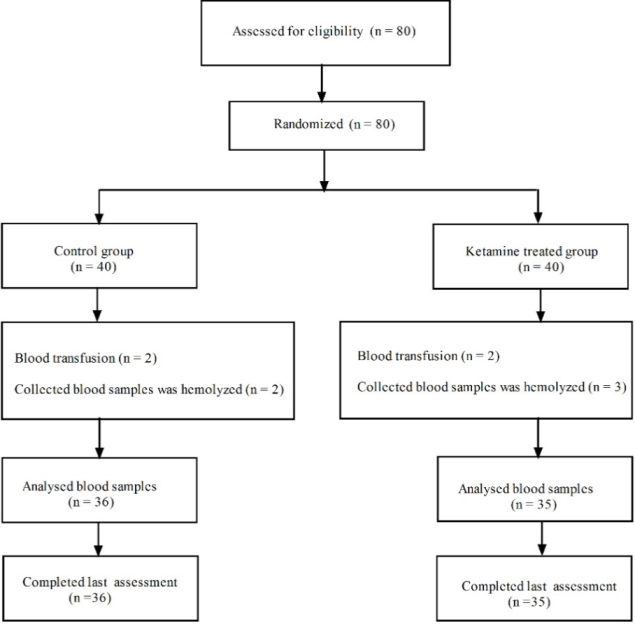
. Following delivery, Apgar scores were recorded at 1 and 5 minutes. The study design is summarized in Figure 1.
2.4. Blood Sample Analysis
Serial maternal blood samples (10 mL each) were obtained via venipuncture at the following time points: T1 (post-intervention), T2 (post-umbilical cord clamping), and T3 (surgical closure). Concomitantly at T2, a 10 mL sample was collected by venipuncture from the umbilical artery after cord clamping. Following centrifugation of blood samples at 3000 × g for 10 minutes at 4°C, the resulting serum supernatant was aliquoted and stored at -80°C until batch analysis. Concentrations of IL-1β, IL-6, TNF-α, BDNF, IgA, IgG, and IgM were quantified using commercial enzyme-linked immunosorbent assay (ELISA) kits (Multi Sciences (Lianke) Biotech) per the manufacturer's protocols. The assays exhibited the following performance characteristics: intra-assay coefficients of variation (CVs) ranged from 2.5% to 8.9%, inter-assay CVs from 0.7% to 8.9%, and sensitivities from 0.02 pg/mL to 5.77 pg/mL for the respective analytes.
2.5. Statistical Analysis
All data were analyzed using SPSS 22.0 (IBM, Armonk, NY, USA). The Shapiro-Wilk test was employed to assess the distribution of continuous variables. Normally distributed data were expressed as mean ± standard deviation (SD) and analyzed using the independent two-sample t-test, while non-normally distributed data were described as median (range) and analyzed using the Mann-Whitney U test. Repeated measures data, such as cytokines, immunoglobulins and BDNF levels, were analyzed using repeated measures analysis of variance (ANOVA). Spearman’s correlation coefficient was used to estimate the correlation of BDNF and inflammatory cytokine levels between the umbilical cord blood and maternal blood at T2. Shivering grade were analyzed using the chi-square (χ²) test and expressed as percentages. P < 0.05 was considered to indicate a statistically significant difference.
2.6. Calculation of Sample Size
As no prior domestic data were available on the effect of 0.25 mg/kg ketamine on inflammatory markers in this context, the sample size was calculated based on its anti-shivering efficacy
[18]
Kose EA, Honca M, Dal D, et al. Prophylactic ketamine to prevent shivering in parturients undergoing Cesarean delivery during spinal anesthesia [J]. J Clin Anesth. 2013; 25(4): 275-280.
. The incidence of shivering during cesarean section is approximately 60% (P₁ = 0.6). We hypothesized that ketamine would reduce this incidence by 90% (P₂ = 0.9). With α = 0.05 and power = 90%, a minimum of 29 participants per group was required. Accounting for a potential 15% attrition rate, we aimed to recruit at least 34 patients per group, resulting in a total enrollment of 80 patients.
3. Results
3.1. Description and Clinical Characteristics of Participants
Figure 1 shows the design of the study. Sociodemographic characteristics (age and BMI), gestational age, Apgar scores, duration of surgery, and times from skin incision to clamp the umbilical cord were comparable among the groups (Table 1).
Table 1. Clinical Characteristics of Neonates and Their Mothers.
Control group
Ketamine group
P-value
Age (years)
29.97 ± 3.25
30.57 ± 3.29
0.443
Maternal BMI (kg.m-2)
27.78 ± 3.11
27.59 ± 2.97
0.796
Gestational age (days)
274.36 ± 5.81
273.06 ± 5.18
0.322
Shivering
0.904
III grade
18 (50.0%)
17 (48.6%)
IV grade
18 (50.0%)
18 (51.4%)
Apgar scores 1 minute
9.41 ± 0.50
9.22 ± 0.54
0.135
Apgar scores 5 minutes
9.52 ± 0.50
9.37 ± 0.49
0.191
Duration of surgery (minutes)
61.88 ± 18.31
62.65 ± 12.51
0.838
Times from skin incision to clamp the umbilical cord (minutes)
3.2 Expression Levels of Inflammatory Factors, BDNF, and Immune Proteins in Maternal and Umbilical Cord Blood
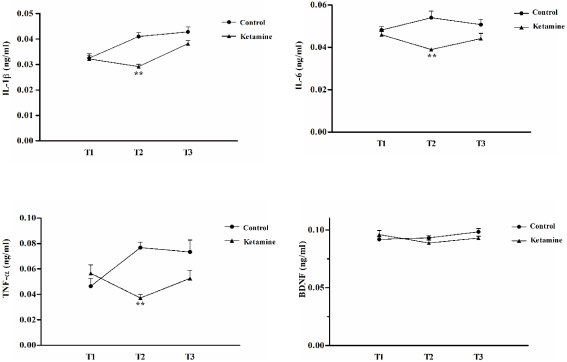
As shown in Figure 2, maternal serum levels of IL-1β, IL-6, and TNF-α (ng/mL) in the control group were significantly elevated at T2 and T3 relative to T1. However, at the T2 time point, the levels of the aforementioned cytokines were significantly lower in the treatment group than in the control group. Furthermore, although IL-6 levels decreased at T3 following ketamine treatment and were lower than those in the control group, this difference did not reach statistical significance.
**P < 0.01 vs control group. T1: after study drug administration, T2: after umbilical cord clamping, T3: at the end of surgery.
Figure 2. The Expression Levels of IL-1β, IL-6, TNF-α and BDNF in Maternal Blood at Time T2.
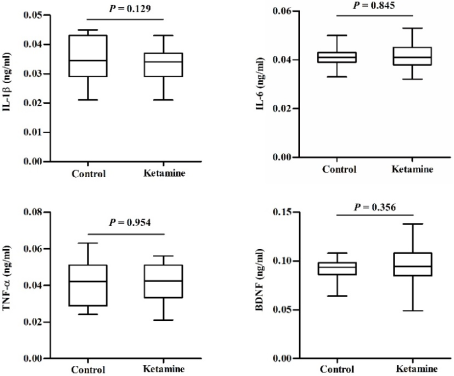
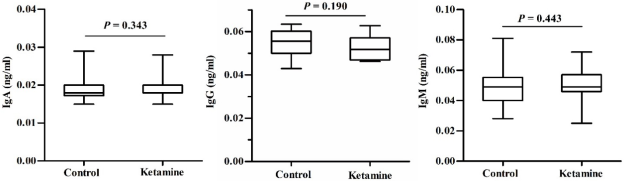
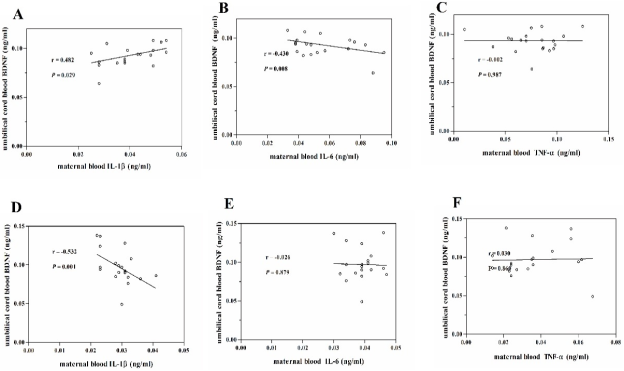
No significant intergroup differences were observed in umbilical cord serum levels of BDNF, the pro-inflammatory cytokines IL-1β, IL-6, and TNF-α (Figure 3), or the immunoglobulins IgA, IgM, and IgG (Figure 4). Furthermore, umbilical cord BDNF levels demonstrated no significant correlations with maternal inflammatory cytokines at the T2 time point (Figure 5).
Figure 5. Association of BDNF Levels in Umbilical Cord Blood and Inflammatory Cytokine Values in the Maternal Blood at T2. (A, B and C are the Control Group; D, E and F Are the Ketamine Group).
4. Discussion
This study demonstrated that a 0.25 mg/kg intravenous dose of ketamine, administered for shivering during cesarean delivery, was effective in mitigating the maternal inflammatory response by significantly reducing serum levels of IL-1β, IL-6, and TNF-α. In contrast, ketamine did not affect the concentrations of these cytokines or BDNF in the umbilical cord circulation.
Pregnancy triggers profound physiological adaptations across multiple systems, including cardiovascular, hematologic, and immunologic functions. Within this context, perioperative stress and inflammatory responses can significantly impact both maternal and neonatal outcomes
[1]
Denizli M, Capitano ML, Kua KL. Maternal obesity and the impact of associated early-life inflammation on long-term health of offspring [J]. Front Cell Infect Microbiol. 2022; 12: 940937.
. This study aimed to establish a novel mechanistic rationale for the use of ketamine in managing shivering and stress following spinal anesthesia for cesarean delivery. The baseline clinical and demographic characteristics were well-balanced between the control and ketamine groups. The administration of low-dose ketamine during cesarean delivery had no observable effect on immediate neonatal outcomes, as assessed by Apgar scores at 1 and 5 minutes. However, its long-term implications for neurodevelopment require further investigation. Potential confounding variables, including total surgical time and the incision-to-delivery interval, were well-matched between groups and did not differ significantly. This careful management of operative timelines ensures that the observed differences in maternal-fetal biomarker transfer are unlikely to be attributable to these procedural factors.
Ketamine functioned as a selective immunomodulator in this context. A low-dose (0.25 mg/kg IV) infusion significantly suppressed maternal pro-inflammatory cytokines (IL-1β, IL-6, TNF-α) during and after cesarean section. This anti-inflammatory effect, however, was not observed in the fetal compartment, as umbilical cord cytokine levels remained unaffected. Furthermore, ketamine did not alter the placental transfer of immunoglobulins, with IgG demonstrating expected maternal-to-fetal passage while IgA and IgM levels were unchanged. Ketamine confers multiple benefits for parturients during cesarean delivery, notably by mitigating shivering, inflammation, and potentially depressive symptoms. Shivering is hypothesized to propagate a pro-inflammatory state during parturition, leading to elevated cytokine levels in maternal circulation
[15]
Mohammadzadeh Jouryabi A, Sharami SH, Mansour Ghanaie M, et al. Comparing the Effects of Low Dose of Ketamine, Tramadol, and Ondansetron in Prevention of Post Spinal Anesthesia Shivering in Cesarean Section [J]. Anesth Pain Med. 2021; 11(4): e116429.
. While direct evidence linking postpartum shivering to cytokine dynamics is limited, Rhind et al. demonstrated that cold exposure can selectively modulate the production of IL-1β, TNF-α, and IL-6, an effect potentially mediated by cold-induced catecholamine release
[19]
Rhind SG, Castellani JW, Brenner IK, et al. Intracellular monocyte and serum cytokine expression is modulated by exhausting exercise and cold exposure [J]. Am J Physiol Regul Integr Comp Physiol. 2001; 281(1): R66-R75.
. Ketamine has a rapid onset of action. Studies have shown that intravenous administration can produce analgesic and sedative effects within minutes
[20]
Barbic D, Andolfatto G, Grunau B, et al. Rapid Agitation Control With Ketamine in the Emergency Department: A Blinded, Randomized Controlled Trial [J]. Ann Emerg Med. 2021; 78(6): 788-795.
. In this study, the average time from the initial skin incision to umbilical cord clamping was approximately 12 minutes. Therefore, we speculate that the changes in maternal blood cytokines at the T2 time point are attributable to the direct immunomodulatory effects of ketamine. All enrolled subjects in this study experienced post-anesthetic shivering, with a shivering severity grade of III to IV. There was no statistically significant difference in shivering grade between the two patient groups, thus eliminating the potential influence of varying shivering severity on the outcomes.
Results of the present study were consistent with those of previous studies, indicating that treatment with ketamine reduced the levels of cytokines in the maternal blood and reduced shivering induced by cesarean section. Notably, increased levels of IL-1β, IL-6 and TNF-α in the maternal blood may promote adverse events in the neonate, as these cytokines may cross the blood placenta barrier into the umbilical cord blood. However, ketamine treatment inhibited the transfer of cytokines, and may therefore inhibit the aforementioned potential adverse events. Due to its ability to cross both the blood-brain and utero-placental barriers, BDNF plays a pivotal role as a mediator of neuronal plasticity, both short-term and long-term, within the central nervous system. Consequently, it exerts a significant influence on fetal brain development
[21]
Agrawal P, Singh P, Singh KP. Vilazodone exposure during pregnancy: Effects on embryo-fetal development, pregnancy outcomes and fetal neurotoxicity by BDNF/Bax-Bcl2/5-HT mediated mechanisms [J]. Neurotoxicology. 2024; 105: 280-292.
. Studies in mouse models suggest that a portion of fetal BDNF is derived from placental transport. Consequently, alterations in maternal BDNF levels may subsequently influence fetal brain development
[22]
Zawadzka A, Cieślik M, Adamczyk A. The Role of Maternal Immune Activation in the Pathogenesis of Autism: A Review of the Evidence, Proposed Mechanisms and Implications for Treatment [J]. Int J Mol Sci. 2021; 22(21): 11516. Published 2021 Oct 26.
. It has been reported that maternal immune activation can impact the fetal brain, leading to neuroinflammation and elevating the offspring's risk of neurodevelopmental and neuropsychiatric disorders, including autism spectrum disorder (ASD), schizophrenia, bipolar disorder, major depressive disorder, and epilepsy
[23]
Lubrano C, Parisi F, Cetin I. Impact of Maternal Environment and Inflammation on Fetal Neurodevelopment [J]. Antioxidants (Basel). 2024; 13(4): 453.
. Results of the present study demonstrated that ketamine did not exert effects on the levels of BDNF; and this may be due to low levels of ketamine used in the present study, or the short treatment duration. This study presents a novel perspective by being the first to combine the anti-shivering and anti-inflammatory effects of ketamine in the context of cesarean section. Furthermore, based on reports linking preoperative anxiety to shivering during cesarean delivery and ketamine's anxiolytic potential, we propose a new hypothesis: that treating shivering may concurrently mitigate anxiety and depression. To validate this, a multi-center, prospective, randomized controlled trial is planned as a primary future research objective.
The present study exhibits numerous limitations. For example, the sample size included in the present study was small, and the present study only included a single center. Further investigations into cytokines derived from T cells are required. In addition, further investigations into the use of thermal blankets and intravenous infusions with heated energic solutions are required.
5. Conclusions
In this patient population, we demonstrate that a minimum effective dose of ketamine safely and effectively alleviates perioperative shivering during cesarean delivery. This effect is associated with a significant reduction in maternal inflammatory cytokines, without altering umbilical cord BDNF or immunoglobulin levels. These findings establish a novel rationale for the use of ketamine in managing shivering in parturients.
Abbreviations
BDNF
Brain-derived Neurotrophic Factor
BMI
Body Mass Index
IL-1β
Interleukin-1β
IL-6
Interleukin-6
TNF-α
Tumor Necrosis Factor-α
NMDA
N-Methyl-D-aspartic Acid or N-Methyl-D-aspartate
Acknowledgments
We extend our sincere gratitude to our families for their unwavering support and continuous encouragement throughout the duration of this study.
All original data will be available when contact the correspondence author by email.
Conflicts of Interests
The authors declare that they have no competing interests.
References
[1]
Denizli M, Capitano ML, Kua KL. Maternal obesity and the impact of associated early-life inflammation on long-term health of offspring [J]. Front Cell Infect Microbiol. 2022; 12: 940937.
Jennen L, De Weerdt L, Kouriannidi E, et al. Cytokine Levels in Mother-infant Pairs at Term and Preterm Delivery [J]. Pediatr Infect Dis J. 2025; 44(2S): S61-S65.
Uram-Benka A, Fabri-Galambos I, Pandurov-Brlić M, et al. Optimizing Newborn Outcomes in Cesarean Sections: A Comparative Analysis of Stress Indicators under General and Spinal Anesthesia [J]. Children (Basel). 2024; 11(7): 783.
Treviño-Garza C, Villarreal-Martínez L, Estrada-Zúñiga CM, et al. Leptin, IL-6 and TNF-α levels in umbilical cord blood of healthy term newborns in relation to mode of delivery [J]. J Obstet Gynaecol. 2016; 36(6): 719-721.
De Berardis D, Tomasetti C, Pompili M, et al. An Update on Glutamatergic System in Suicidal Depression and on the Role of Esketamine [J]. Curr Top Med Chem. 2020; 20(7): 554-584.
Nowak W, Grendas LN, Sanmarco LM, et al. Pro-inflammatory monocyte profile in patients with major depressive disorder and suicide behaviour and how ketamine induces anti-inflammatory M2 macrophages by NMDAR and mTOR [J]. EBioMedicine. 2019; 50: 290-305.
Yu G, Jin S, Chen J, et al. The effects of novel α2-adrenoreceptor agonist dexmedetomidine on shivering in patients underwent caesarean section [J]. Biosci Rep. 2019; 39 (2): BSR20181847.
Kumar K, Lin C, Symons T, et al. Narrative Review on Perioperative Shivering during Caesarean Section under Neuraxial Anaesthesia [J]. Rom J Anaesth Intensive Care. 2023; 29(1): 41-46.
Liu J, Wang Y, Ma W. Shivering prevention and treatment during cesarean delivery under neuraxial anesthesia: a systematic review [J]. Minerva Anestesiol. 2018; 84(12): 1393-1405.
Mohammadzadeh Jouryabi A, Sharami SH, Mansour Ghanaie M, et al. Comparing the Effects of Low Dose of Ketamine, Tramadol, and Ondansetron in Prevention of Post Spinal Anesthesia Shivering in Cesarean Section [J]. Anesth Pain Med. 2021; 11(4): e116429.
Jayaraj A, Balachander H, Kuppusamy SK, et al. Comparison of meperidine, tramadol and fentanyl for post-spinal shivering prevention during cesarean delivery: A double-blind randomized controlled trial [J]. J Obstet Gynaecol Res. 2019; 45(11): 2202-2208.
Kose EA, Honca M, Dal D, et al. Prophylactic ketamine to prevent shivering in parturients undergoing Cesarean delivery during spinal anesthesia [J]. J Clin Anesth. 2013; 25(4): 275-280.
Barbic D, Andolfatto G, Grunau B, et al. Rapid Agitation Control With Ketamine in the Emergency Department: A Blinded, Randomized Controlled Trial [J]. Ann Emerg Med. 2021; 78(6): 788-795.
Zawadzka A, Cieślik M, Adamczyk A. The Role of Maternal Immune Activation in the Pathogenesis of Autism: A Review of the Evidence, Proposed Mechanisms and Implications for Treatment [J]. Int J Mol Sci. 2021; 22(21): 11516. Published 2021 Oct 26.
Yu, Z., Liu, Y., Huang, Z., Pan, D. (2025). Effects of Ketamine on the Profile of Cytokines and Bdnf in Maternal and Umbilical Cord Blood During Cesarean Delivery. American Journal of Clinical and Experimental Medicine, 13(6), 184-192. https://doi.org/10.11648/j.ajcem.20251306.14
Yu, Z.; Liu, Y.; Huang, Z.; Pan, D. Effects of Ketamine on the Profile of Cytokines and Bdnf in Maternal and Umbilical Cord Blood During Cesarean Delivery. Am. J. Clin. Exp. Med.2025, 13(6), 184-192. doi: 10.11648/j.ajcem.20251306.14
Yu Z, Liu Y, Huang Z, Pan D. Effects of Ketamine on the Profile of Cytokines and Bdnf in Maternal and Umbilical Cord Blood During Cesarean Delivery. Am J Clin Exp Med. 2025;13(6):184-192. doi: 10.11648/j.ajcem.20251306.14
@article{10.11648/j.ajcem.20251306.14,
  author = {Zhi-yang Yu and Yang Liu and Zu-chao Huang and Dong-ge Pan},
  title = {Effects of Ketamine on the Profile of Cytokines and Bdnf in Maternal and Umbilical Cord Blood During Cesarean Delivery},
  journal = {American Journal of Clinical and Experimental Medicine},
  volume = {13},
  number = {6},
  pages = {184-192},
  doi = {10.11648/j.ajcem.20251306.14},
  url = {https://doi.org/10.11648/j.ajcem.20251306.14},
  eprint = {https://article.sciencepublishinggroup.com/pdf/10.11648.j.ajcem.20251306.14},
  abstract = {Objective: Shivering is a frequent and undesirable complication of cesarean section with spinal anesthesia. The present study aimed to determine the effects of ketamine on the levels of cytokines, immunoglobulins and brain-derived neurotrophic factor (BDNF) during cesarean section-mediated perioperative shivering. Methods: In this randomized controlled trial, eighty patients undergoing cesarean section were enrolled. They were randomly allocated to one of two groups: a control group (n = 40) that received normal saline, and a ketamine group (n = 40) that received ketamine at a dose of 0.25 mg/kg. Maternal blood samples were collected at three predefined time points: after study drug administration (T1), after umbilical cord clamping (T2), and at the end of surgery (T3). Results: At the T2 time point, the ketamine group exhibited a significant reduction in maternal cytokine concentrations compared to the saline control. Umbilical cord immunoglobulin concentrations were comparable between groups. Moreover, no correlation was found between umbilical cord BDNF and maternal cytokine levels at T2. Conclusions: Ketamine alleviated cesarean section-mediated perioperative shivering via diminishing cytokines, without impacting the levels of BDNF or immunoglobulins. Moreover, ketamine treatment decreased the levels of cytokines in the maternal blood; thus, abrogating the risk of transferal into the neonate.},
 year = {2025}
}
TY  - JOUR
T1  - Effects of Ketamine on the Profile of Cytokines and Bdnf in Maternal and Umbilical Cord Blood During Cesarean Delivery
AU  - Zhi-yang Yu
AU  - Yang Liu
AU  - Zu-chao Huang
AU  - Dong-ge Pan
Y1  - 2025/12/29
PY  - 2025
N1  - https://doi.org/10.11648/j.ajcem.20251306.14
DO  - 10.11648/j.ajcem.20251306.14
T2  - American Journal of Clinical and Experimental Medicine
JF  - American Journal of Clinical and Experimental Medicine
JO  - American Journal of Clinical and Experimental Medicine
SP  - 184
EP  - 192
PB  - Science Publishing Group
SN  - 2330-8133
UR  - https://doi.org/10.11648/j.ajcem.20251306.14
AB  - Objective: Shivering is a frequent and undesirable complication of cesarean section with spinal anesthesia. The present study aimed to determine the effects of ketamine on the levels of cytokines, immunoglobulins and brain-derived neurotrophic factor (BDNF) during cesarean section-mediated perioperative shivering. Methods: In this randomized controlled trial, eighty patients undergoing cesarean section were enrolled. They were randomly allocated to one of two groups: a control group (n = 40) that received normal saline, and a ketamine group (n = 40) that received ketamine at a dose of 0.25 mg/kg. Maternal blood samples were collected at three predefined time points: after study drug administration (T1), after umbilical cord clamping (T2), and at the end of surgery (T3). Results: At the T2 time point, the ketamine group exhibited a significant reduction in maternal cytokine concentrations compared to the saline control. Umbilical cord immunoglobulin concentrations were comparable between groups. Moreover, no correlation was found between umbilical cord BDNF and maternal cytokine levels at T2. Conclusions: Ketamine alleviated cesarean section-mediated perioperative shivering via diminishing cytokines, without impacting the levels of BDNF or immunoglobulins. Moreover, ketamine treatment decreased the levels of cytokines in the maternal blood; thus, abrogating the risk of transferal into the neonate.
VL  - 13
IS  - 6
ER  -
Department of Anesthesiology, Wuxi Huishan District People’s Hospital, Wuxi, China;Department of Anesthesiology, Jinling Hospital, Nanjing Medical University, Nanjing, China
Yu, Z., Liu, Y., Huang, Z., Pan, D. (2025). Effects of Ketamine on the Profile of Cytokines and Bdnf in Maternal and Umbilical Cord Blood During Cesarean Delivery. American Journal of Clinical and Experimental Medicine, 13(6), 184-192. https://doi.org/10.11648/j.ajcem.20251306.14
Yu, Z.; Liu, Y.; Huang, Z.; Pan, D. Effects of Ketamine on the Profile of Cytokines and Bdnf in Maternal and Umbilical Cord Blood During Cesarean Delivery. Am. J. Clin. Exp. Med.2025, 13(6), 184-192. doi: 10.11648/j.ajcem.20251306.14
Yu Z, Liu Y, Huang Z, Pan D. Effects of Ketamine on the Profile of Cytokines and Bdnf in Maternal and Umbilical Cord Blood During Cesarean Delivery. Am J Clin Exp Med. 2025;13(6):184-192. doi: 10.11648/j.ajcem.20251306.14
@article{10.11648/j.ajcem.20251306.14,
  author = {Zhi-yang Yu and Yang Liu and Zu-chao Huang and Dong-ge Pan},
  title = {Effects of Ketamine on the Profile of Cytokines and Bdnf in Maternal and Umbilical Cord Blood During Cesarean Delivery},
  journal = {American Journal of Clinical and Experimental Medicine},
  volume = {13},
  number = {6},
  pages = {184-192},
  doi = {10.11648/j.ajcem.20251306.14},
  url = {https://doi.org/10.11648/j.ajcem.20251306.14},
  eprint = {https://article.sciencepublishinggroup.com/pdf/10.11648.j.ajcem.20251306.14},
  abstract = {Objective: Shivering is a frequent and undesirable complication of cesarean section with spinal anesthesia. The present study aimed to determine the effects of ketamine on the levels of cytokines, immunoglobulins and brain-derived neurotrophic factor (BDNF) during cesarean section-mediated perioperative shivering. Methods: In this randomized controlled trial, eighty patients undergoing cesarean section were enrolled. They were randomly allocated to one of two groups: a control group (n = 40) that received normal saline, and a ketamine group (n = 40) that received ketamine at a dose of 0.25 mg/kg. Maternal blood samples were collected at three predefined time points: after study drug administration (T1), after umbilical cord clamping (T2), and at the end of surgery (T3). Results: At the T2 time point, the ketamine group exhibited a significant reduction in maternal cytokine concentrations compared to the saline control. Umbilical cord immunoglobulin concentrations were comparable between groups. Moreover, no correlation was found between umbilical cord BDNF and maternal cytokine levels at T2. Conclusions: Ketamine alleviated cesarean section-mediated perioperative shivering via diminishing cytokines, without impacting the levels of BDNF or immunoglobulins. Moreover, ketamine treatment decreased the levels of cytokines in the maternal blood; thus, abrogating the risk of transferal into the neonate.},
 year = {2025}
}
TY  - JOUR
T1  - Effects of Ketamine on the Profile of Cytokines and Bdnf in Maternal and Umbilical Cord Blood During Cesarean Delivery
AU  - Zhi-yang Yu
AU  - Yang Liu
AU  - Zu-chao Huang
AU  - Dong-ge Pan
Y1  - 2025/12/29
PY  - 2025
N1  - https://doi.org/10.11648/j.ajcem.20251306.14
DO  - 10.11648/j.ajcem.20251306.14
T2  - American Journal of Clinical and Experimental Medicine
JF  - American Journal of Clinical and Experimental Medicine
JO  - American Journal of Clinical and Experimental Medicine
SP  - 184
EP  - 192
PB  - Science Publishing Group
SN  - 2330-8133
UR  - https://doi.org/10.11648/j.ajcem.20251306.14
AB  - Objective: Shivering is a frequent and undesirable complication of cesarean section with spinal anesthesia. The present study aimed to determine the effects of ketamine on the levels of cytokines, immunoglobulins and brain-derived neurotrophic factor (BDNF) during cesarean section-mediated perioperative shivering. Methods: In this randomized controlled trial, eighty patients undergoing cesarean section were enrolled. They were randomly allocated to one of two groups: a control group (n = 40) that received normal saline, and a ketamine group (n = 40) that received ketamine at a dose of 0.25 mg/kg. Maternal blood samples were collected at three predefined time points: after study drug administration (T1), after umbilical cord clamping (T2), and at the end of surgery (T3). Results: At the T2 time point, the ketamine group exhibited a significant reduction in maternal cytokine concentrations compared to the saline control. Umbilical cord immunoglobulin concentrations were comparable between groups. Moreover, no correlation was found between umbilical cord BDNF and maternal cytokine levels at T2. Conclusions: Ketamine alleviated cesarean section-mediated perioperative shivering via diminishing cytokines, without impacting the levels of BDNF or immunoglobulins. Moreover, ketamine treatment decreased the levels of cytokines in the maternal blood; thus, abrogating the risk of transferal into the neonate.
VL  - 13
IS  - 6
ER  -





 Share This Article
 Twitter
 Linked In
 Facebook
 Copy
Copy Download